scroll 1

Welcome to my blog breaktheandroid.blogspot.com here you can surf my blog tutorials for to get root access of your android smartphones and able to update your knowledge in new technologies and the market trend of smart phones and technology era

Navigation

scroll 2

Happy to announce that our Android App Is ready to download in Play Store click here to download the application and stay updated

Showing posts with label app. Show all posts

Monday, September 28, 2015

Google Targets Intent With Email, YouTube And Search Matching And Universal App Campaigns

As Ad Week rolls into New York, the tech giants are rolling out their ad product news. Today Google announced moves further into Facebook-style targeting territory, with a new product called Customer Match that will let advertisers upload lists of emails and match them to signed-in Google users on Gmail, Search and YouTube. Google is also upping its game in app promotions.
Meanwhile, Facebook has announced a new service that itself is competitive with yet another platform: Twitter, and specifically in the area of nabbing more TV ad dollars. The social network will be working with Nielsen on a new metric and ad buying option to let advertisers more closely link their TV ad spend with Facebook video spend.
Google’s Customer Match — which will be getting rolled out in the next few weeks — will let advertisers build campaigns based around email address lists that they upload and match against Google’s own database of signed-in users across some of its biggest properties — including Gmail, YouTube and Search.
In an example given by  Sridhar Ramaswamy, SVP of Ads and Commerce at Google, a travel brand can upload the names of people in its rewards program, who will then be served ads from that travel brand the next time they are searching a relevant term. Similarly those ads (or others like them) can then follow a user when she or he visits YouTube or checking email on Gmail.
On top of this, Google will also be giving advertisers the ability to use that same data to find similar audiences — that is, signed-in users who may not be on your own lists but match profiles of those who are and are therefore more likely to be interested in your products.
If you think all of this sounds familiar, it’s because it is: Facebook has been letting advertisers run similar styles of campaigns based around customer databases for years already. Why has Google been so slow to come around to this? Regulatory scrutiny seems to be one key reason highlighted by Digiday, which had reported that targeting plans were in the works before Google made the news official: the search giant has been happy to let others take the lead on this kind of ad tech first because then Google appears as the competitor when it enters the market.
There could be other reasons, too: You could also argue that Google has been so successful with its core search products that the idea of adding new features may have been put on the backburner. Similarly, it may only be now that advertisers are showing so much interest in targeting and ad tech in general that Google has felt the push to roll out similar products itself.
The push from the wider market, and competition from Facebook, it could be argued, may also be behind the new Android app promotion tools that Google is also unveiling.
This is not the first time that Google has leveraged its larger networks in areas like search to promote apps: Google unveiled some initiatives in this space back in Mayduring its big I/O developer conference. Now we have a more complete picture in the form of Universal App Campaigns.
Essentially, what this is is a new type of AdWords product focused specifically on targeting app users across different Google platforms such as Search, Google Play, YouTube, and the Google Display Network, which Google says covers some 2 million websites. Some of this is similar to the intent that Google is trying to capture with Customer Match: a search for adventure gaming apps will yield an ad for, say, an adverture game. What’s less clear is if that intent then follows you to other platforms, or whether Google creates separate intent-based ads in, say, YouTube based on what you are watching.
As with other app-install networks, Google says a developer sets a cost-per-install in order to set up a campaign across different platforms.

Facebook’s video ambitions

If Google is wading deeper into Facebook’s territory with app install ads and email-based advertising databases, Facebook is also dipping its toes elsewhere, too.
Earlier today, Facebook, which says it now works with 2.5 million advertisers (up from 2 million in February), announced that it would work with Nielsen to develop and introduce a new metric that it calls the “total rating point” (TRP) to measure how Facebook video ads perform alongside corresponding TV ad campaigns. “Marketers can plan a campaign across TV and Facebook with a total TRP target in mind, and they can buy a share of those TRPs directly with Facebook,” Facebook notes in a blog post about the new product.
As with Nielsen’s early moves to work more closely with Twitter to measure and match up Twitter users with TV consumers, the idea here is to create a stronger link between the old platform and the new in order to encourage more advertising on the latter platform. Video is huge on Facebook, and the social network killing from video ads in its news feed (which are increasingly also going mobile). Making more products to align those even more closely, and with TV advertisers’ budgets, makes a lot of sense.
Other new Facebook products today include brand awareness optimization bidding; polling services coming to mobile; and — in one more push to enhance and expand video inventory — adding videos to the carousel format Facebook introduced earlier this year.

Tuesday, September 8, 2015

Microsoft is going out of its way to ensure you are using Edge on Windows 10

Microsoft is unquestionably the authority when it come the end-user PC market, but despite the whopping success of Windows throughout the years, the US giant just never seems to get it right with web browsers. Ever since the days of Netscape, Internet Explorer has been consistently outstaged by some leaner, prettier, faster and more standard-compliant alternative.


Shaking such a deplorable reputation, be it deserved or not, has proven a nearly impossible task and despite the new direction, total redesign, better performance and even totally new name, the Microsoft Edge browser is still having a hard time retaining a loyal audience. But you don't have to trust me on that, the statistics speak for themselves.


In any case, Microsoft has now hatched a new, slightly more aggressive plot to make you stick with the Edge browser that comes bundled with Windows 10. It appears that the first time you open up the browser and use Microsoft's own Bing search, which is unsurprisingly also set as a default and look up "Chrome" or "Firefox", the results come up along with a quite serious looking gray information strip, explaining that Microsoft Edge is the recommended choice on Windows 10.


Now, we can definitely understand this desire for a clean slate and a new chance for Edge, but Microsoft is heading down a slippery slope yet again. Let's look back a little bit, shall we. A few years ago after a major industry scandal unfolded with accusations that Microsoft was abusing it OS monopoly to push Internet Explorer on users, a EU ruling forbid the company from setting it as a default browser and gave birth to a peculiar default browser chooser. That was back in 2009 and you might have missed it altogether, if you happen to live outside the European Union. The said regulations were active for five years and are no longer in place since the beginning of 2015.


While this does mean that Microsoft is free to push Edge, the question can easily be rekindled and such banners are a risky gamble. On the other hand, all you loyal Microsoft fans out there can rest assured that Edge or a similar built-in browser isn't going away any time soon. Default or not, it is still a vital component of windows, needed for a lot of core and third-party apps to function. So chances are that in a way we are all Edge users, it all depends on how you look at it.
Source | Via

Tuesday, August 25, 2015

Increase Internal Memory of Your Phone

You know Internal memory is such an important part of your Android Phone. All the apps are installed here. The users with high end phones never face a problem with internal memory. But the users with low end phones often are forced to keep only selected apps on their phones as their internal memory is very less. But do not worry know, asrootmyandroid is here for the rescue. In this post I will shoe you that how you could increase your internal memory by using a memory card.

Partition Memory Card:

So as to be bale to use a memory card as an internal memory and add to it, you must first have a partitioned memory card. So there are a number of ways you could be partitioning your memory card. here we will be suing a app named as Link2SD. This app allows your phone to use a part of the memory card as an internal memory and moves those apps on the memory card. But also latest Android versions have the same functionality but thestill the files of those apps are left on the internal memory, and again you have to limit the number of apps you can install on your phone. But if you use Link2SD you could increase your internal memory of phone by no limits. Offcourse you will need a SD card accordingly. So let’s start. There are two ways by which you can partition your memory card, and here they go.
  • First install the mini Partition Wizard Manager. here is the download link.
  • insert the card reader into a card reader and open it in computer.
  • Backup all the files present on your memory card, as in the process of making a partition you need to wipe all the data on the SD card.
  • Open the tool you installed, and open the Memory Card in it.
  • Right click on it, and select the “delete” option.
  • increase-internal-memory
    • Right click on it again, and now select the option “Create New”, Create a “FAT32″ partition. This will be the part of the memory card, where all your media files will be stored.
    • Then Select “Create as: Primary”
    partition-memory-card
    • Then, create an ext2/ext3/ext4 partition ( if you are on stock ROM choose ext2). This is the place all your apps will be stored.
    • Then select “Create as:primary”  (Make sure that it is both set as primary, because it will not be working if it is not set to primary).
    • And now click on the “Apply” button on the top corner, and wait for the changes to take place. Congrats you have successfully partitioned the memory card by first method.

Alternate Method to Partition Memory Card:

here is an alternate method to make a partition on your memory card. For this method you need the ClockwordMod installed on your Phone. So if you don’t have CWM installed, do not use thismethod, go with the above method. If yu have CWM installed, you can choose anyone. Note: This method works for both Stock ROM and Custom ROM as well.
  • Backup all your files on memory card.
  • Go into the recovery mode of your phone.
  • Select “Advanced”, ad then choose “Partition SD Card”.
  • Then Choose your SD-ext size ( Like if you have a 2GB Memory Card, choose 512 MB, and if you have a 4 GB Memory card, you can choose 1024 MB).
  • Select 0 Swap.
  • wait for the process to finish, ad then Reboot the phone. Congrate you’ve just made a partition on your memory card, and that’s ready to use.

Increase Internal Memory by Link2SD :

By  now you must have made a partition on your memory card, by either way. So it is now the time to increase your internal memory, the internal memory of the phone. So that you can installas many apps as you want, and to your heart’s content. So follow these steps below.
  • Download and install the Link2SD app. Download link here. Note: This app needs root access, so this trick would only work if you have rooted your phone.
  • Open Link2SD. You will be prompted to choose between ext2,ext3,ext4 and FAT32. Now if you have made partition suing first method choose “ext2″ and if you have used the second method then choose “ext4″.
increase-memory-link2sd
  • Then it will say, Mount Script Created. Now you Reboot your Phone.
  • Now open Link2SD, if any message doesn’t appears, it means you succeeded.
  • Now go to Link2SD > Setting> Check the autolink. (to automatically move apps upon installation).
partition-sd-card-cwm
  • If you already have some apps, select “create link” ( be sure to check the files: app, dalvic-cache, and library files).
increase=internal-memory-an
  • Now to check the memory, select “Storage Info” . this will be showing you up the current status of your internal memory.
  • And Final Congratulations, you are done, now you can install as many apps as you want.
If you have any doubts, feel free to ask the queries in the comments below. I hope this helped. :)


Thursday, April 30, 2015

Amazon Expands Business-Sales Marketplace After Three Years

Zuma Press
After three years of testing, Amazon.com is hoping to widen the reach of its business customer marketplace site with a rebranding and expanded product selection.
Amazon Business, as the site will be known, will offer some merchandise exclusively to business customers, as well as better prices for some goods, said Prentis Wilson, a company vice president. Amazon is phasing out Amazon Supply in mid-May in favor of the new site, which will require a business license to access.
The new marketplace, which will continue to sell things like beakers, wrenches, and wood sanders, potentially gives Amazon a leg up in a capturing sales that otherwise rely heavily on catalogues and specialty sites like industrial supplier Grainger.
Among the goods offered at special prices on Amazon Business are a Belkin iPad air case for $23.81, compared with $29.81 on Amazon.com and a Fellowes adjustable keyboard tray at $191.43 versus $209.82, according to a spokeswoman.
Wilson declined to say if the distinct pricing on Amazon Business was the result of the Seattle company’s contract with suppliers or whether Amazon is altering the prices itself after paying wholesale.
He said the site will also have business-specific advertising and products not offered elsewhere. Those include scientific goods like antibodies and protein screening kits, among “hundreds of millions” of other items.
In other ways, the site will operate like Amazon.com. Members of Amazon’s $99 Prime program will get unlimited two-day shipping and many of the goods will be stored in Amazon warehouses, said Wilson.
For now Amazon Business will be only for U.S. customers, but Wilson suggested it could expand internationally over time.

Wednesday, April 29, 2015

40M Active Small Business Pages in Facebook

Facebook is announcing some new programs today for small businesses, particularly ones that advertise. At the same time, the company’s also arguing that plenty of businesses find out value on the social network without buying ads.
Specifically, Facebook says the number of active small business Pages keeps growing — it’s up to 40 million, compared to 30 million last June. And only 2 million of them are active advertisers.
The fact that there are so many active businesses that don’t bother with ads seems particularly noteworthy given the declining reach of organic (non-ad) content from Facebook Pages. But Jonathan Czaja, Facebook’s director of small business for North America, said that creating Pages isn’t just about pushing posts to potential customers.
“Creating a presence on Facebook … is a powerful asset in its own right,” he said.
As for those new programs, Facebook will be holding more events for small businesses around the country, with half-day events in San Diego, Minneapolis, Nashville and Boston.
And for advertisers, it’s also adding one-on-one chat support. The idea of customer support through chats might not seem all that unusual or worth celebrating, but again, we’re talking about millions of advertisers here.
Before now, if you were a small business buying ads on Facebook and you needed help, you had to send an email and wait for a response. Czaja said many of those advertisers were asking for live support, so Facebook is giving it to them. It’s rolling out the program in the United States, United Kingdom, and Ireland in the next few months, with more countries to follow.
“We’ve got hundreds of reps worldwide providing both email and chat support,” Czaja said. “We intend to grow that dramatically in the coming years.”

Instagram Launches @Music

Instagram today announced the launch of a new official community on its service dedicated to music and musicians that will live under the handle @music. This marks the first time the company has created a dedicated account devoted to a single subject, explains the Facebook-owned social network in a blog post out this morning.
The idea for the new community was sparked by activity on Instagram itself, as one-quarter of the most popular accounts on Instagram today are those coming from musicians. Now Instagram is working to further fuel the flames of its 300 million+ users’ interest in the subject.
Explains Instagram founder and CEO Kevin Systrom, “The music community is — and always has been — an important part of Instagram. For the past four years, we have become the home for artists big and small — a place where people across the musical spectrum come to share stories, reveal their creativity and connect directly with fans,” he writes.
A number of popular artists today have Instagram accounts, including Beyonce, Taylor Swift, Rihanna, Katy Perry, Justin Bieber, Madonna and more. But it has also become home to emerging artists, who are looking to grow their fan base.
The new @music community, which will be headed up by Instagram Music Editor Alex Suskind, will cover a range of topics related to music, says Instagram, including all kinds of artists, both up-and-comers like Tricot and stars, instruments, lyrics, studio sessions, concerts, album illustrations, music fans and more.
There will be just six posts per week added to this account and they will be grouped into series designated by specific hashtags. For example: #LocallySourced will cover unsigned acts, #DoubleTrack will focus on artists’ interests outside of music, and #15SecondLessons will include videos on how to perform “everything from riffs to drumbeats,” says Instagram.
The “community” aspect to the service involves getting @music followers to participate not only in the comments of the posts itself, but also with a new, music-themed monthly hashtag project, the company notes. This will be similar to the Weekend Hashtag Project Instagram currently runs on its main @Instagram account, only tailored to music community.
The main account has over 60 million followers, and is used by the company to spotlight creative members of its community. @Music is an extension of that.
The @music community is kicking off its launch today with the first feature on Questlove. Unlike many Instagram posts, these community contributions aren’t just a simple photo or video and a quick comment, but rather include long-form content. In the case of Questlove, for example, there’s a multi-paragraph article that provides a deeper look into the artist’s musical origin story.
The decision to branch into verticals focused on users’ interests is an interesting move for the photo-and-video sharing network, which had not before launched its own online communities to engage the service’s users in a meaningful way. If @music is successful, it could mean that Instagram will use it as a model to expand into other areas that also make sense for its user base, with other dedicated accounts like those for art or fashion, for example.
That would perhaps make the service more of a rival to networks like Twitter or Snapchat, for instance – the former which also serves as a way for musicians and other public figures to communicate with their fans, and the latter which has more recently expanded into content as well, with the launch of the news-focused section “Discover.”
However, Instagram says today it doesn’t have plans to launch other verticals at this time or run ads on @music. Rather, the company tells us, @music is an expansion of Instagram’s long-running editorial operation. “Creating content isn’t new for us,” an Instagram spokesperson explains. “We think spotlighting the most talented and creative members of the music community on Instagram is a very strategic long-term.”In addition, having an online topic-based community could help Instagram attract advertisers who want to reach a specific audience – Instagram’s younger, music-obsessed fans, that is. Today, there’s not a good way for advertisers to target a narrow demographic on the service because its users’ profiles are kept free from information that could help an advertiser identify their demographic data or interests. An online community (or communities) could eventually change that.

Twitter’s New Dedicated Food Account Could Help Broaden Appeal

Twitter is launching @TwitterFood today, a dedicated account that sifts through the myriad food-related tweets shared on the social network and offers up a curated selection of hand-picked missives from heavyweights in the field, including Martha Stewart and Alton Brown, as well as choice posts from the general public.
The Twitter Food account is a smart idea for a company looking to expand its appeal in order to find a new, more general audience. While the network has a strong cadre of die-hard users, it’s still struggling to gain a foothold in the broader market the way Facebook has managed to do.
Food isn’t the company’s first curated feed; Twitter Music and Twitter Sports operate in much the same way, for instance. But focusing on areas of high engagement that’s more likely to appeal to user groups beyond news hounds and real-time information junkies is a wise decision.
Onboarding remains one of the biggest challenges facing Twitter in terms of growth; curated feeds like Twitter Food offer one-stop shopping for new users, giving them a smattering of high-quality content relevant to their needs from which they can branch out and find new follows to fill their timeline.
 The financial picture painted by Twitter’s earnings release yesterday isn’t all that rosy, and user growth was a key causal factor there, so anything that can contribute to growth is a worthwhile effort right now.It’s also a good way to avoid irritating faithful users of the service but keeping the basic mechanics (i.e. time-based timelines) in place while making it easier for new users to get beyond the initial “so what now?” feeling that can accompany signing up without any close friends to follow or clear intent in terms of why you joined.

Airbnb Finally Releases An App For Browsing Its Listings On Tablets

Airbnb Finally Releases An App For Browsing Its Listings On Tablets
A few weeks ago, I was looking for an Airbnb in Austin to share with my girlfriend while we’re in town for a buddy’s wedding. We were specifically looking to find a place that didn’t involve sleeping in an Airstream or someone’s converted garage, and a place where we were unlikely to be awoken in the morning by some hippie’s chickens.*
After some period of frustration handing my laptop back and forth while we browsed listings, my girlfriend had a brilliant idea. She would download the app on her iPad, and then we’d have a slightly less annoying device to pass between us. But then, after a quick search on the app store:
“There’s no iPad app. What the hell?”
I was just as surprised. After all, Airbnb has been around for so long that we just sort of expected there had to be an iPad app. But there wasn’t — at least not until today.
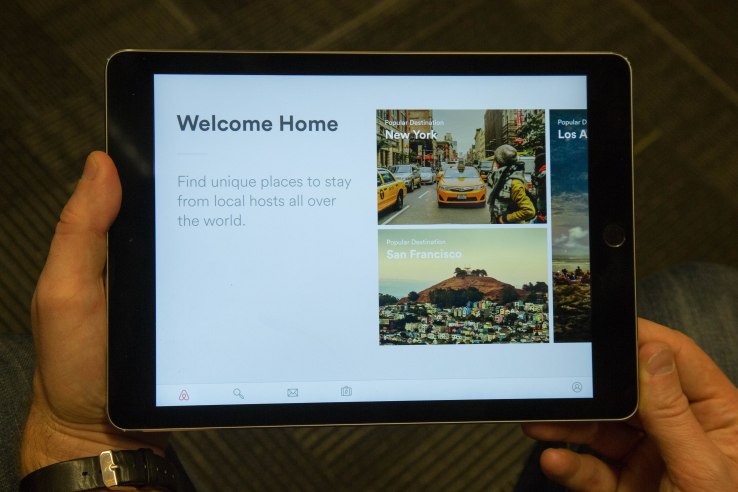
That’s right, today Airbnb is finally** rolling out an app that will enable users to browse and search its listings on a device that’s bigger than a phone, but not quite as unwieldy as a laptop. But more than that, the new app for iPad and Android tablets is designed to provide users with some inspiration for where they might want to take their next trip.
The app was designed to target a huge — and growing! — number of users who already use Airbnb on their tablets. According to Airbnb head of design Alex Schleifer, about 12 percent of all Airbnb users are coming to the site via iPad.
But the company didn’t want to just build a scaled-up iPhone app, or port over a more “native” version of its responsive web experience for tablets. It wanted to build something new and special for tablet users.
Like everything Airbnb does, the tablet app just oozes design. While it’s built for utility — yeah, the search field is just a tap away, and it’s really easy to get over to your messages with hosts or guests — the company also wanted to show off all the wonderful places you could be staying, even if you don’t have anywhere you plan to go.
When you first open it, the what-body-part-is-it Airbnb logo (the Bélo!) appears in animation while the names of different cities flash across the screen. It’s like a loading screen for a video game, but in this case it’s totally unnecessary — except, you know, to look cool.
airbnb ipad 2
Beyond that, the app welcomes you with beautiful images of all the various locations you can browse through, letting you swipe right and left between them. It’s meant to feel like you’re thumbing through a travel magazine, which in a way, you kind of are.
“People hold the iPad like a magazine or like a book,” Schleifer explains. “We wanted to bring the quality of print design into the digital space.”
In each viewing mode, the app seeks to highlight beautiful imagery while keeping the nitty gritty details slightly hidden but easily accessible. When you choose a city to browse in, you’re shown large panes of property images with listing price and a short description. Peeking out of the left side of the screen is a map that can be used to bounce around or refine your search, if you choose.
Click through to any listing and you’re engulfed in full-bleed images. Airbnb likes to say it has the largest collection of professional home photography in the world, and the company loves to sow that off in the app. Property information is a flick of the wrist away, slightly hidden in the bottom pane of the screen.
The app also has all the tools hosts have come to expect, including the ability to edit listings, manage their calendars, and also quickly reply to messages from guests. It also provides all host stats and dashboard — what Schleifer calls the host command center.
With the app, Airbnb had a couple of constituencies it wanted to please — those who will use the app mainly for browsing, and those who want to just get down to business and book.
“We thought about how different people use Airbnb. I use it to sit back and explore, let it guide where I want to go,” Schleifer told me, which was behind the idea of making it more of a magazine. But then there are other people, he says, that want the design to “just get out of the way and let me book.”
It was a long time coming, sure, but it appears Airbnb has an app that succeeds on both fronts.

Saturday, April 25, 2015

With Lydia, Pay From Apple Watch for Your Online Purchases

Step by step, Lydia is unveiling its product strategy to handle all your payments. When I last covered the French startup, it was still mostly focused on growing its user base by providing a Venmo alternative for French users. But now, Lydia also lets you pay on e-commerce websites, starting with PriceMinister. The app is now also available on the Apple Watch so that you can just tap on your watch notification to order something online.
“We think that Lydia’s mission is to make it easier to use your money,” co-founder and CEO Cyril Chiche told me. “We don’t want to be a great app to pay back your friends, nor a great app to pay online. We want to offer as many use cases as possible to our users.”
There are now three use cases for Lydia. The Venmo-like feature lets you pay back your friends in a few taps without having to pay any fee. It uses your good old debit card to pay someone. And if you don’t want to keep any money in the app, you can withdraw it to your bank account — it’s free as well.
Second, retail stores can accept Lydia in addition to cash and cards. When someone wants to pay using Lydia, they can open the app, enter the amount and show a QR code to the merchant. Merchants have to pay 0.3 percent per transaction and a monthly plan between €4.90 and €49.90. It is a lot cheaper than credit card terminals.
Finally, e-commerce websites will soon get a “Pay with Lydia” button as well. When you click on the button and Lydia detects that you already have the app based on your phone number, the company’s servers send a push notification to your phone. You open the app, enter your PIN code, select your debit card and you are done.
Once again, Lydia bets on very low fees to attract e-commerce merchants. Processing a transaction costs 1.5 percent and a fixed €0.06 fee — it’s much cheaper than PayPal or Stripe. “Before launching our e-commerce offering, we needed a great user experience, and of course fraud protection and very low fees,” Chiche said.
And the user experience is even better if you have an Apple Watch, because the notification will show up on your wrist. It’s totally optional, but early Apple Watch users should appreciate the integration. And it’s true that tapping on your wrist sounds much easier than typing your credit card number.
The company raised $3.9 million late last year (€3.6 million) from XAnge Private Equity, Belcube and Duval’s family office. Now, it is facing an important challenge. If it wants to become a ubiquitous payment solution on the web, it still needs to convince multiple big e-commerce partners to work with the company.
lydia-watch-en-01

Headout Raises $1.8 Million For Its Travel App That Puts A Concierge In Your Pocket

Headout, a mobile travel application that functions as sort of a mobile concierge, helping you find tours, activities and tickets to local events in select U.S. cities, has closed on $1.8 million in seed funding in order to expand its business to new markets. Currently only live in New York and Los Angeles, the startup says it plans to utilize the funds to reach 12 more cities by year-end.
This includes expansions into San Francisco, Los Angeles, Chicago, Washington D.C., Miami, and others over the next few months.
San Francisco and L.A. will be live next month, the company notes.
Describing itself as an “Uber for tours,” the startup first began as Bangalore-based Tourlandish, and was initially targeting travel to and from Asia. But the company, which later participated in the 500 Startups accelerator program, shut down that app and relaunched with one focused on New York tours and events instead.
After being live in New York for around six months, Headout launched in Las Vegas as its second supported city.
Today, Headout has close to 500 last-minute activities available in its application, which the startup reports is anywhere from five to ten times more than its competitors offer. There are also 300 more vendors on waitlists for inclusion.
Not all vendors are able to participate in Headout, however. Instead, the company tests out the activities in advance in order to vet them. If approved, the vendors are then given access to their own standalone mobile application that allows them to control when their activities are made available to Headout users. That is, they can use the service to quickly fill unsold inventory by listing the number of seats or tickets available and reducing the prices, if they choose.
The idea with the consumer-facing app is to quickly connect travelers with a variety of travel experiences, ranging from theater tickets to helicopter tours to dinner cruises and more with just a few taps. The app breaks these down into various categories within the app for easy access, and even makes its own recommendations in an “Editor’s Choice” section.


In addition, the startup is developing algorithms that will personalize its recommendations even further, taking the larger inventory available and narrowing it down to just those activities that best match up with travelers’ interests. Today, those algorithms only look at basic data like where the app is opened, time of day, and weather, for example, but in an upcoming release it will tap into social data from Facebook and Twitter, as well. This will allow it to understand an individual’s interests, by pulling insights gained from their likes and status updates.
Co-founder and CEO Varun Khona says the idea for the company was sparked by a European road trip he and co-founder Suren Sultania once took. They realized that the existing online marketplaces were lacking in availability and in interesting “long-tail” activities, while their pricing was the same as buying directly as a walk-in. You also had to print out physical vouchers, which seemed fairly dated.
Screenshot-2
“Overall, they had built their mobile apps as an afterthought, and the business wasn’t built around the spontaneous or on-demand use case,” says Khona. “We knew there are a lot of folks like us who do not pre-book their holiday activities and an app meant to do just that in the easiest way possible sounded like an exciting idea to work on,” he adds. They realized as they went to work on what became Headout that the space was lacking a decent aggregator, which is why the company’s long-term goal is to become that brand for any destination in the world.
Since its launch last July, Headout claims to have booked activities for “tens of thousands” of customers who hail from over 65 countries worldwide. Khona says the business has been doubling every month, and is expected to grow ten times this year, thanks to its forthcoming expansions. The company takes 20% of its ticket sales to generate revenue, he notes.
Screen Shot 2015-04-24 at 11.56.47 AM
Headout is backed by Version One Ventures, an early-stage fund focused on investments in consumer internet, software-as-a-service and mobile businesses. Founding partner at Version One Ventures and board partner at Andreessen Horowitz, Boris Wertz, said his firm’s interest in Headout was due to the opportunities they see in mobile-first marketplaces.
Other investors in the seed round include 500 Startups, Nexus Venture Partners, Arena Ventures, AngelList’s Maiden Lane Ventures, Funders Club, Haystack Fund, Ludlow Ventures, DreamIt Ventures as well as angel investors Semil Shah, Rick Marini (advisor to Facebook), Fabrice Grinda (OLX), Kunal Bahl and Rohit Bansal (Snapdeal), Steve Barsh and Neeraj Arora (WhatsApp).
In addition to helping fuel the expansions, the San Francisco-headquartered company is hiring across the board in engineering, sales, operations, and more. The company is also working with others in the travel space which will be using its API in their products and services, but is not yet ready to name partners at this time.

Instagram Cuts Off Hot GIF App Phhhoto From Its Social Graph

“Removed instagram friend-finding cause they blocked us! #nochill” This note in hip GIF app Phhhoto‘s latest release notes was how it announced its users can no longer easily follow their Instagram friends. Instagram confirmed to me that it has blocked Phhhoto’s Find Friends access, but it has a policy of not discussing platform enforcement issues regarding specific developers.
It’s likely that Instagram believed Phhhoto was violating its policy that developers not “Use the Instagram APIs for any application that replicates or attempts to replace the essential user experience of Instagram.com or the Instagram apps.” That’s understandable considering Phhhoto’s vertical feed based photo social network bears many similarities to Instagram.
This enforcement is essentially the same thing that Twitter did to Meerkat, cutting off its Find Friends access because it replicates Periscope functionality (though when Meerkat was built atop Twitter, it didn’t know Twitter owned Periscope). Instagram similarly cut off Kevin Rose’s now-deceased photo app Tiiny back in October.
Phhhoto’s app lets you record for about two seconds to create a silent, looping, animated GIF. You can then share this GIF to social networks like Facebook, Twitter, and Tumblr. It’ll also appear in the Phhhoto feed to your followers, and if it gets enough likes it could end up on its ‘Wow’ tab.
Phhhoto still lets users save their Phhhoto GIFs as videos and instantly push them over to Instagram to be published. But without the option for Phhhoto users to recreate their social graph from the world’s top photo app, it might have a harder time lacing people together and keeping them engaged.
Screen Shot 2015-04-24 at 12.24.26 PM
Phhhoto’s founders aren’t too worried though, as Champ Bennet told me “it wasn’t too surprising, and we’re not really sweating it. They’ve done it before to Tiiny, so we kinda saw it coming. When we were building the feature we even saw it as a possibility.”
It seems that Phhhoto’s founders understand why Instagram might think it replicates their functionality. It is in fact another photo feed app, though Instagram uses real videos that loop with sound, rather than GIFs. Bennet says “We thought it would be fun to drop it in the release notes but there’s no hard feelings.”
phhhotobooth
Luckily Phhhoto already has over 1 million registered users, has seen 10 million posts, and has risen in the iOS app charts to break the top 500 overall this month. Its physical photo booths that can upload to the app have also become a hit at parties in Silicon Valley.
Still, Phhhoto is massively dwarfed by Instagram’s 300 million-plus active users. If anything, the move makes Instagram look a little insecure and threatened by a competitor less than 1/300th its size. And it begs the question: Is Instagram looking to get into GIFs?