scroll 1

Welcome to my blog breaktheandroid.blogspot.com here you can surf my blog tutorials for to get root access of your android smartphones and able to update your knowledge in new technologies and the market trend of smart phones and technology era

Navigation

scroll 2

Happy to announce that our Android App Is ready to download in Play Store click here to download the application and stay updated

Showing posts with label Microsoft. Show all posts

Tuesday, September 8, 2015

Microsoft is going out of its way to ensure you are using Edge on Windows 10

Microsoft is unquestionably the authority when it come the end-user PC market, but despite the whopping success of Windows throughout the years, the US giant just never seems to get it right with web browsers. Ever since the days of Netscape, Internet Explorer has been consistently outstaged by some leaner, prettier, faster and more standard-compliant alternative.


Shaking such a deplorable reputation, be it deserved or not, has proven a nearly impossible task and despite the new direction, total redesign, better performance and even totally new name, the Microsoft Edge browser is still having a hard time retaining a loyal audience. But you don't have to trust me on that, the statistics speak for themselves.


In any case, Microsoft has now hatched a new, slightly more aggressive plot to make you stick with the Edge browser that comes bundled with Windows 10. It appears that the first time you open up the browser and use Microsoft's own Bing search, which is unsurprisingly also set as a default and look up "Chrome" or "Firefox", the results come up along with a quite serious looking gray information strip, explaining that Microsoft Edge is the recommended choice on Windows 10.


Now, we can definitely understand this desire for a clean slate and a new chance for Edge, but Microsoft is heading down a slippery slope yet again. Let's look back a little bit, shall we. A few years ago after a major industry scandal unfolded with accusations that Microsoft was abusing it OS monopoly to push Internet Explorer on users, a EU ruling forbid the company from setting it as a default browser and gave birth to a peculiar default browser chooser. That was back in 2009 and you might have missed it altogether, if you happen to live outside the European Union. The said regulations were active for five years and are no longer in place since the beginning of 2015.


While this does mean that Microsoft is free to push Edge, the question can easily be rekindled and such banners are a risky gamble. On the other hand, all you loyal Microsoft fans out there can rest assured that Edge or a similar built-in browser isn't going away any time soon. Default or not, it is still a vital component of windows, needed for a lot of core and third-party apps to function. So chances are that in a way we are all Edge users, it all depends on how you look at it.
Source | Via

The latest Skype beta by Microsoft comes with Windows 10 Mobile support

Microsoft’s latest Skype beta for Windows 10 comes with support for the mobile version of the OS as well. Users can try out the new version of the popular messenger if they are running a preview build of Windows 10 Mobile.
The new Skype beta for Windows 10 Mobile aims to become the default messaging solution. Just like Apple iMessage and Google Hangouts, the application can handle sending SMS or Skype chats seamlessly.
Skype calling on the other hand, becomes part of the phone app in Windows 10 Mobile. Skype Video, as its name suggests, will handle video chats.
The new beta is available only for Insider users for the time being. Microsoft is yet to announce its official availability.

Saturday, August 1, 2015

Microsoft announces which Lumias will get Windows 10 first

The desktop PC version of Windows 10 has been out since yesterday, but the mobile variation of Microsoft's latest OS is still in the making. Furthermore, we don't even have an exact release date for Windows 10 Mobile yet, so it may take a few months for it to actually surface. In fact, the latest rumors on the matter talk about a November launch.
In the meantime, however, you might want to know which Lumia-branded smartphones are going to get the update to Windows 10 first. Microsoft has helpfully published an official list.


So, if you own a Lumia Lumia 430, Lumia 435, Lumia 532, Lumia 535, Lumia 540, Lumia 640,Lumia 640 XL, Lumia 735, Lumia 830, or Lumia 930, you'll be among the first people on the planet to experience the final version of Windows 10 Mobile when it hits.
If you have a different Lumia, there's no reason to panic just yet. Microsoft has confirmed that the above are not the only Lumias to get Windows 10, just the first in line for the update. So the new OS should make its way to many more models at some point. In all cases, the update to Windows 10 Mobile will be free.
On this occasion, Microsoft has once again promised that all Lumias running Windows Phone 8.1 with the Denim software will eventually get upgraded to Windows 10.
Source | Via

Wednesday, June 10, 2015

MicrosoftStore.com now offers unlocked Lumia phones

If you're looking for a SIM-free Lumia, you should check out MicrosoftStore.com. The US and UK stores offer the most options, but regional versions of the site may also have something to offer.


The US store offers the Lumia 830 ($450), Lumia 535 ($150), Lumia 635 ($130), among others. In the UK featured headsets include Lumia 830 (£270), Lumia 435 (£60) and Lumia 640 XL LTE (£220).
You can also grab some accessories from the Microsoft Store. Here's the list of unlocked phones in the US and in the UK.

Thursday, May 7, 2015

Microsoft quietly testing new Lumia with 4.7" screen in India

Microsoft has decided to attack the entry-level smartphones category in India by introducing multiple models. While the high-end Lumia devices remain work-in-progress, yet another budget-level Windows Phone device is being tested in India.


As per Zauba's import data, Microsoft is testing a Lumia phone with RM-1127 product code. This phone has a 4.7" display and is a single-SIM device.
Bearing a declared value of INR4,578, the actual price of this phone might be significantly higher, as noted in the case of Lumia 640 and Lumia 640 XL recently. Since the Lumia RM-1127 is only being tested, it might take couple of months for it to release formally.
Source | Via

Tuesday, May 5, 2015

Microsoft to launch two high-end Lumia phones later this year

Microsoft recently shared more details on the Windows 10 OS for desktops but didn't give us much on its phone platform. Later, the operating system group chief Joe Belfoire noted that the Windows 10 for phones will arrive later this year.
Now we learn Microsoft is also planning to introduce two high-end Lumia devices with its latest platform. These Lumia devices can be expected to run Windows 10 out of the box.


Out of the two, a premium model with codename Cityman will sport a 5.7-inch QHD display, an Qualcomm Snapdragon chipset with octa-core CPU, 3GB of RAM, 32GB of expandable storage, and a 3,300 mAh removable battery. The Cityman will feature a 20MP rear snapper which hopefully carries the PureView lineup a step further and a 5 MP front camera.
Meanwhile, Talkman will feature a 5.2-inch QHD display, a Qualcomm Snapdragon SoC with hexa-core CPU, 3GB of RAM, 32GB built-in storage, and 3,000 mAh battery. This one will also have a 20MP rear snapper and 5MP front camera.
There's no way of verifying the validity of this report so take it with a healthy pinch of salt.

Windows 10 for smartphones will not launch this summer

Microsoft will not launch Windows 10 for smartphones this summer. The Redmond giant’s Corporate Vice President Joe Belfiore delivered the new at a Build media event in San Francisco.
As it turns out, Microsoft is focused on launching Windows 10 for PC first. Builds of the new OS for smartphones are said to be behind in their development compared to their desktop counterparts.
The above strategy by Microsoft should hardly catch anyone by surprise. The company pulled a similar trick with the launch of Windows 8.1 - its variant for smartphones (Windows Phone 8.1) arrived at a later stage.

Wednesday, April 29, 2015

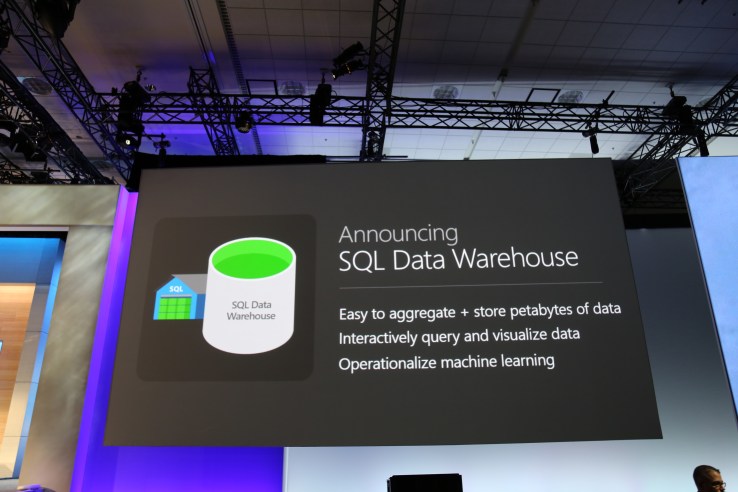
Microsoft Introduces Azure SQL Data Warehouse

Microsoft today announced a new service in its Azure database lineup during its Build developer conference keynote today. The Azure SQL Data Warehouse, which will go into public preview in June, is meant to give businesses access to an elastic petabyte-scale, data warehouse-as-a-service offering that can scale according to their needs.
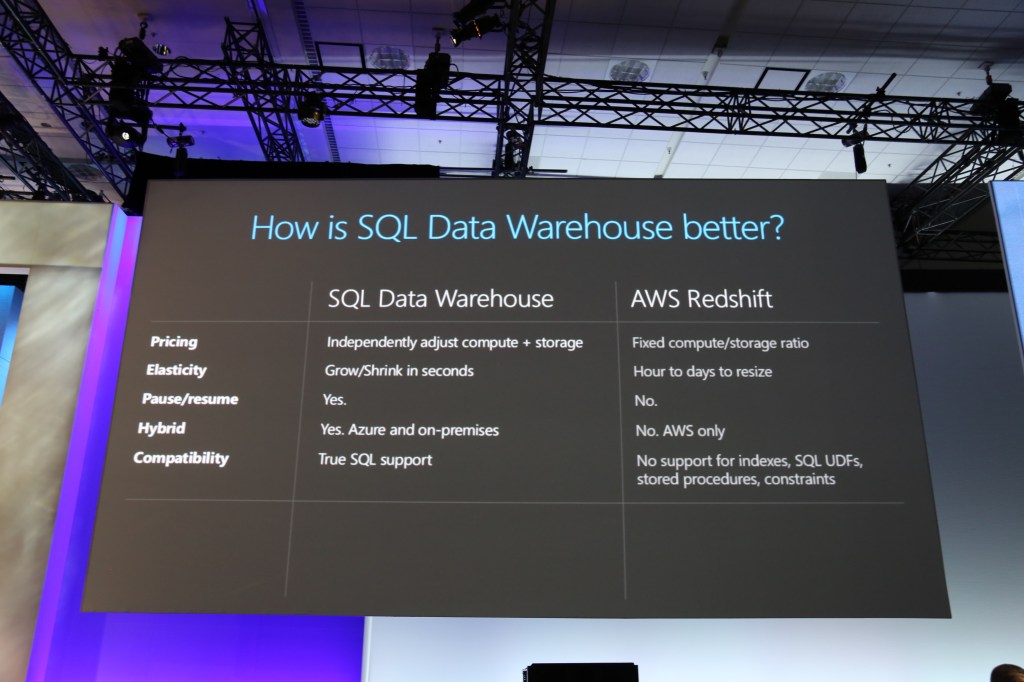
With SQL Data Warehouse, enterprises can ensure that they only pay for the usage they need and when they need it, Microsoft’s corporate VP for its data platform T.K. “Ranga” Rengarajan told me earlier this week. Customers are billed for their Azure blob storage, as well as the hourly compute rates they incur while working with the data. Because it separates compute and storage, users only pay for the queries they need. This means a business can aggregate all of its data and only pays for storage until it needs to run a quarterly report over this information, for example.
sql_lake
As Microsoft notes, the service is meant to give businesses the features they expect from their databases like full indexing, partitions and columnar indexing. The company also argues that other data warehouses can take hours or days to resize, while SQL Data Warehouse can adjust to a user’s needs in minutes. As the name implies, the query language for the service is SQL (specifically Microsoft SQL Server’s Transact-SQL), which most developers are probably familiar with at this point.
2I8A9219
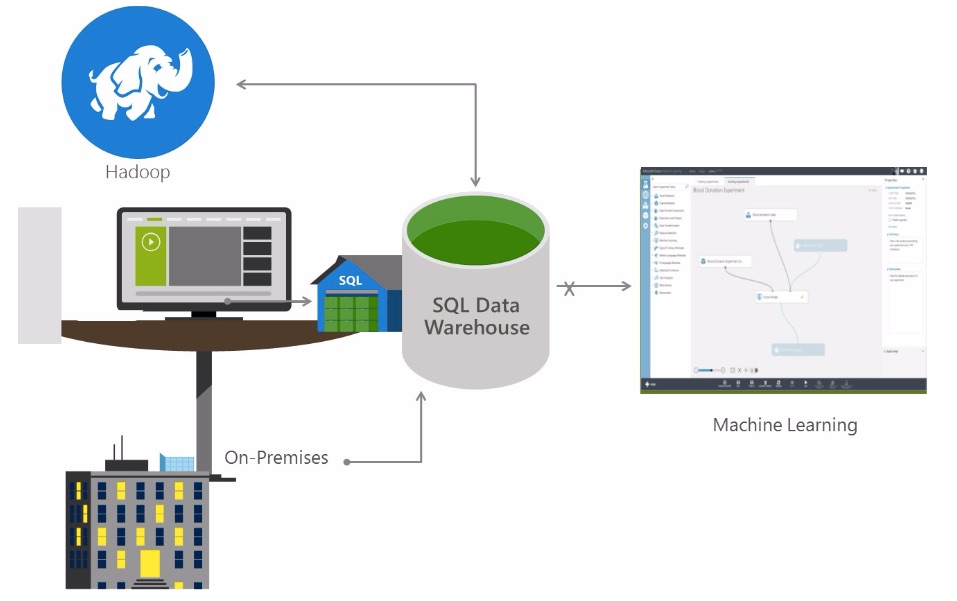
The service can be integrated with other tools like PowerBI for visualizing data, Azure Machine Learning, Azure Data Factory for event processing and Azure’s HDInsight Hadoop-based big data analytics service.
With SQL Data Warehouse, Microsoft adds yet another product to its range of database services that now include SQL Database for regular relational databases and the DocumentDB NoSQL document database, as well as tools like StorSimple for storing and securing large amounts of data.

Microsoft’s New Add-In Frameworks Let Developers Access Office’s Data Graph

2I8A9327
At its Build event in San Francisco, Microsoft just showed off its new add-in frameworks for Office that let developers build applications on top of the company’s productivity apps that will run everywhere Office does.
Instead of siloing data off within its productivity suite, Microsoft CEO Satya Nadella said that Microsoft wants to “move to a semantically rich graph of data that developers can view and extend.”
These mini-applications aren’t limited to Windows (or even the desktop). Since they’re built in HTML and JavaScript, the same add-in that users become familiar with on their PC at the office will also show up when they make a quick change in the app on the iPad or web versions of Word, Excel, PowerPoint or Outlook.
In an on-stage demo, Nadella and an Office Product Manager showed several applications from early partners, including a DocuSign app running within Word and an add-in from SAP running in Excel, pulling data from what the user is looking at and automatically turning it into something easier to work with.
Nadella says these new frameworks will make Office applications more powerful by allowing for sub-apps that fit within specific user contexts — thus offering the benefits of broadly applicable and powerful apps like Excel while also bringing in interfaces and tools built for niche user bases.

Microsoft Expects 1 Billion Windows 10 Devices In 2-3 Years

At its Build developer conference today, Microsoft announced that it expects Windows 10, its forthcoming operating system, to run on 1 billion devices in two to three years. That’s the idea, at least.
The goal is reasonable, given the company’s decision to offer Windows 10 to current Windows 7, 8, and 8.1 users for free for a year. That, combined with the normal PC sales cycle and the upgrade of Windows Phone users, is how Microsoft gets to the 1 billion-device figure.
Keep in mind two things: Microsoft has granted itself quite a lot of wiggle room — a multi-year timeframe that has a full year of slack is a pretty wide band. But that’s hardly surprising, given that Microsoft has something at risk in this case. If the company cannot attract a mass of users quickly, developers might pass on building for the platform.
And if developers don’t opt-in, consumers might eschew using the Windows Store. That cuts downloads, revenue for Microsoft and, of course, developer incomes. It’s a negatively reinforcing cycle.
The 1 billion figure is a good stab into the future for Microsoft (who can ignore that amount of potential reach?), and it’s a benchmark that now must be met. Windows 10 is coming out in a few months, and then for Microsoft, this particular clock begins to tick.

Microsoft’s New Browser->Microsoft Edge

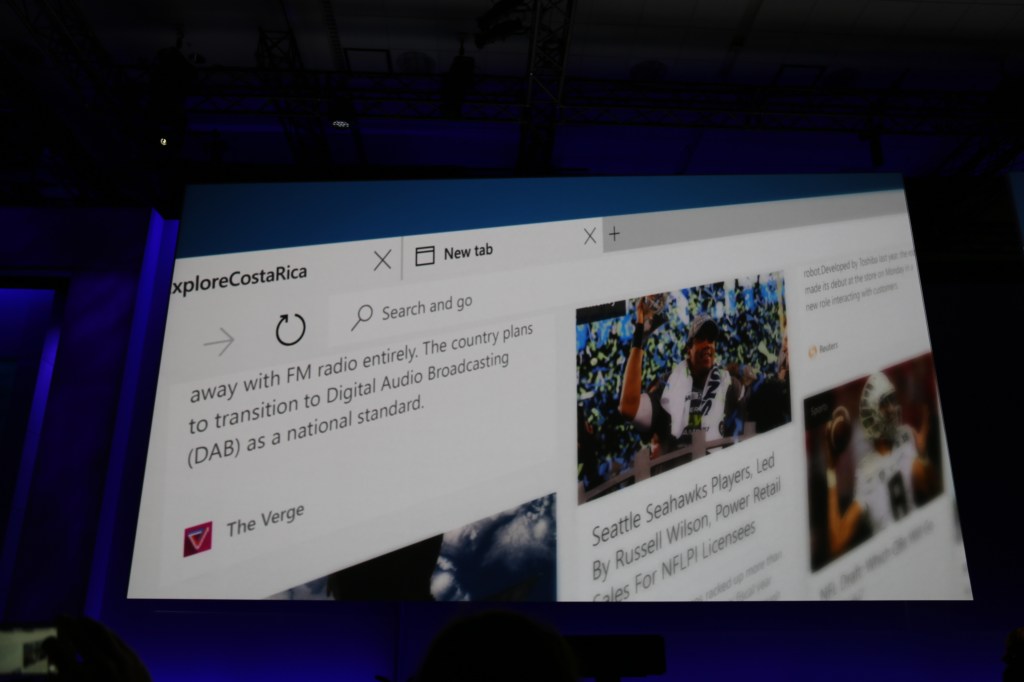
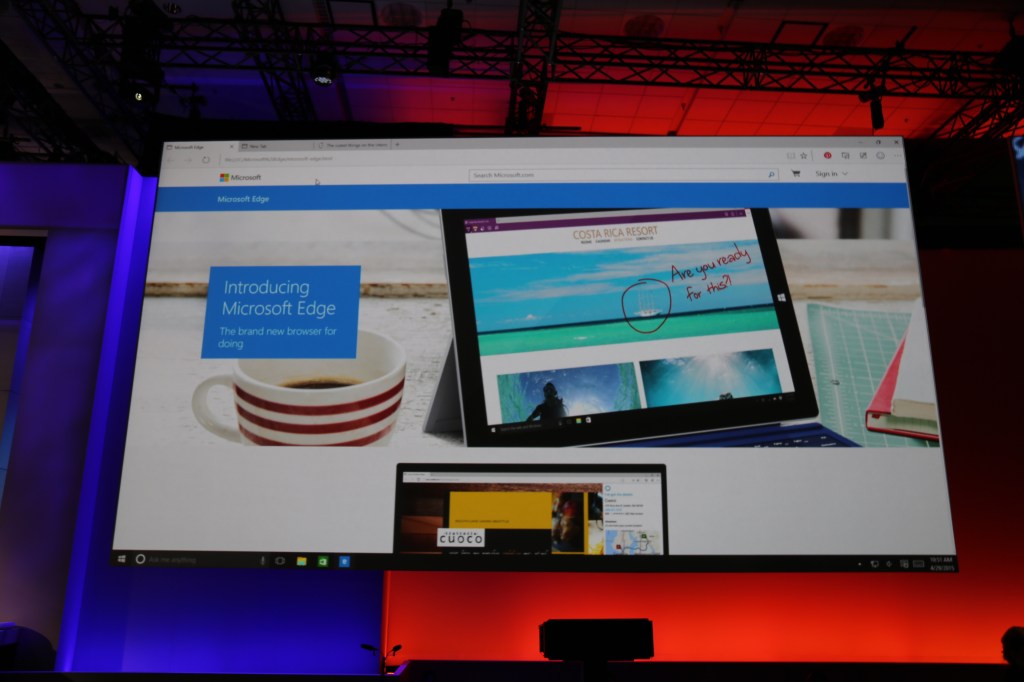
2I8A9586
We knew that Internet Explorer was dead.
We knew a successor was coming.
We just didn’t know the official name, beyond the “Project Spartan” placeholder.
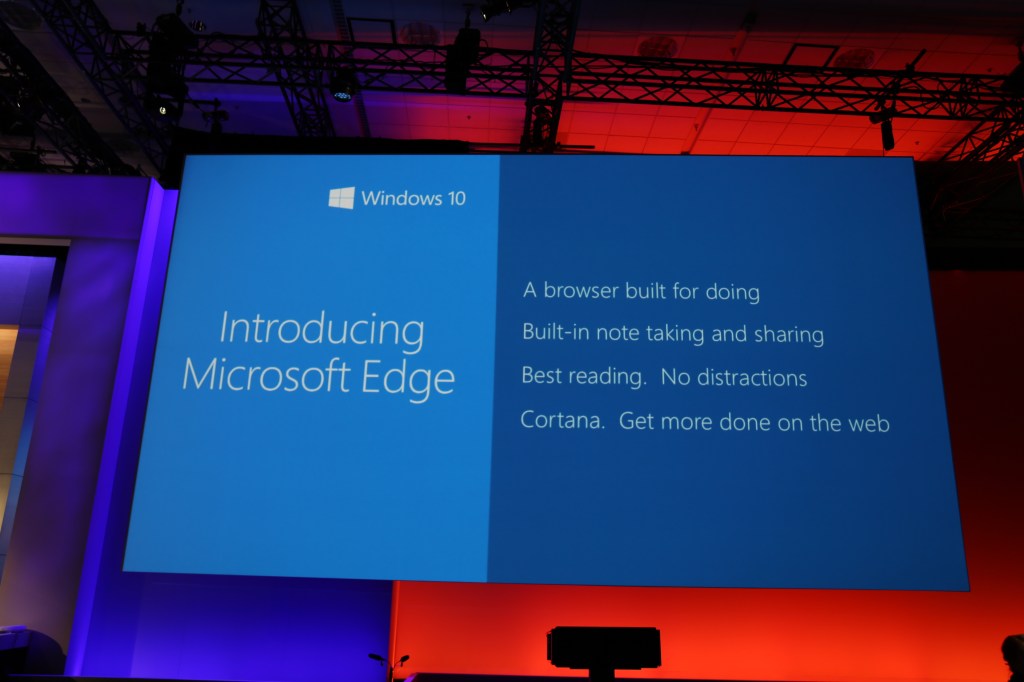
Now we do: Microsoft’s new browser is called Microsoft Edge.
Just announced at the company’s build conference, Edge will be the primary/default browser built into Windows 10.
Details are still light on of what’s unique to Edge, but here’s what we know:
  • It has built in Cortana support
  • It has built-in reader, note-taking, and sharing features
  • The design focuses on simplicity and minimalism
  • The rendering engine is called EdgeHTML
While no fullsize screenshots have been released yet, here’s what we could grab from the demo screen as it debuted:
2I8A9574
2I8A9587

Microsoft Launches Visual Studio Code

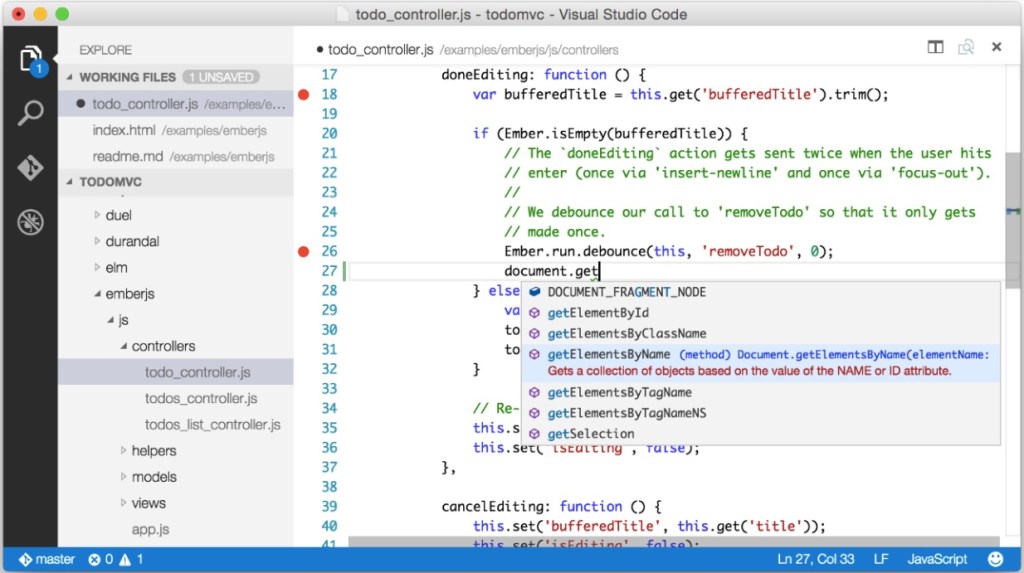
At its Build developer conference, Microsoft today announced the launch of Visual Studio Code, a lightweight cross-platform code editor for writing modern web and cloud applications that will run on OS X, Linux and Windows. The application is still officially in preview, but you can now download it here.
This marks the first time that Microsoft offers developers a true cross-platform code editor. The full Visual Studio is still Windows-only, but today’s announcement shows the company’s commitment to supporting other platforms.
visua_studio_code
“A lot of people use Windows as their development environment, but we are also seeing a lot of people on Linux and Mac,” S. ‘Soma’ Somasegar, Microsoft’s corporate VP of its developer division, told me earlier this week. “Instead of making them go to Windows, we want to meet them where they are.” Developers on these platforms are also often perfectly happy with using a regular code editor like Sublime Text instead of a full IDE like Visual Studio.
Visual Studio Code offers developers built-in support for multiple languages and as Microsoft noted in today’s Build keynote, the editor will feature rich code assistance and navigation for all of these languages. JavaScript, TypeScript, Node.js and ASP.NET 5 developers will also get a set of additional tools.
2I8A9076
The editor features all of the standard tools you would expect from a modern code editor, including syntax highlighting, customizable keyboard bindings, bracket matching and snippets. Somasegar tells me it also works with Git out of the box and
As Somasegar told me, the new editor is partly based on Microsoft’s experience with writing the online Monaco editor for Visual Studio Online, but the company also worked on bringing some of Visual Studio’s language features to Visual Studio Code. These include the Roslyn project, for example, Microsoft’s .NET compiler platform and Microsoft says the language services it built for Visual Studio Code will be available in other editors as well, including Sublime Text, Vi and Atom.
visual_studio_code_2
Some of these language features are also available to other editors. Not too long ago, Microsoft launched a TypeScript plug-in for Sublime Text, for example, and Somasegar tells me the company is committed to launching similar projects in the future (it’s all about meeting developers where they are, after all).
Today’s announcement will surely come as a surprise to many. It does, however, fit in well with the direction the company’s developer group has been on for quite a while now, be that the open sourcing of .NET Core (and taking that platform cross-platform) or the launch of the free Visual Studio Community edition.

Watch the Microsoft Build event live here

Microsoft's annual BUILD conference is just minutes away and we will be keeping a close eye on the announcements and especially the all-important keynote presentation. It is set to start at 3:30PM GMT and, naturally, Microsoft has promised a live stream, which we will provide as soon as possible, so you can tag along and listen in to the future on Windows.

Over 


The company's immensely popular OS is undoubtedly going to be the central topic at the conference. But, unlike previous years, when the discussion has been mostly centered around PC's and tablets, Windows 10 marks a major expansion in the company's strategy and thus promises to cover plans and projects spanning across a wide array of devices and tech branches.
That is the new Microsoft ideology - one Windows, a unified, as far as possible, OS that can provide a uniform experience across all of your devices. That is the ultimate goal of Windows 10 and we can expect a lot of talk about the new Universal Apps that will allow developers to use a unified coding standard and target a sea of Windows 10 devices, including PCs, mobile phones and even Xbox One.


We have already seen some demos of the new app ecosystem, but a lot is still unknown about how exactly apps will behave on various mobile devices running Windows 10, especially ones with a bigger screen. So, we are hoping to see a lot of new demonstrations during the presentation. Speaking of Apps and branching out, rumors hint that Microsoft may be planning to integrate its functionality and services across an array of third-party operating systems as well. There have been talks about Cortana on Android and even iOS devices, as well as new cloud-based services.
But Microsoft's cross-platform plans don't stop there. The company's aim is to aid developers in every way possible and make the new application ecosystem a breeze to migrate to. This is perhaps the most vital thing Microsoft has to achieve in order to stay relevant in the mobile world. Consequently, a lot of the new development tools that will come with Windows 10 might me created in such a way as to ensure easy migration of existing code from Android or iOS over to Windows 10. This, of course involves API compatibility and a lot of software tricks, but it could potentially give a major boost to the new OS. There have even been bold statements about native Android apps running on Windows 10, but we consider that highly unlikely.


And even though Microsoft's BUILD event are mostly geared towards software, we expect to hear quite a few things about hardware as well. Microsoft made it clear that new Lumia flagships will probably be held off until Windows 10 becomes official, but new details on future devices are not out of the question.
There are also other things to look forward to, like information on HoloLens, the Internet of things and many, many more, so be sure to tune in for the event.

Saturday, April 25, 2015

Microsoft And Google Battle Once Again For Title Of Second Most Valuable Tech Company

They’re back at it.
After reporting earnings yesterday, Google and Microsoft are once again locked in their long-running battle for second. Apple, the most valuable technology company, is also the most valuable company in the world, with Google and Microsoft rounding off the top three.
Google, up 3.56 percent as of the time of writing, is currently worth $385.59 billion. Microsoft, up 9.47 percent, is worth a similar $389.24 billion. Earlier, the companies managed a $388 billion moment of parity. Their shares are still gyrating, so we could see the companies pass the baton back and forth before the day’s regular hours come to a close.
There is rich history of watching Apple, Microsoft and Google fight for the top three. Let’s rewind:
TechCrunch, May 26, 2010: “Boom, Indeed: Apple Passes Microsoft In Market Cap.”
Worth just over $227 billion apiece, Apple passed Microsoft’s value in 2010. Apple has since more than tripled in value. Microsoft is up a more modest 71 percent.
TechCrunch, February 14, 2011: “Apple Now The Most Valuable Tech Company By $100 Billion; Google Closing In On Microsoft.”
Apple was now worth $330 billion and Microsoft $228 billion. Put another way, Apple’s value grew by $100 billion, or just under a third in less than a year. Microsoft was all but unch.
TechCrunch, October 17, 2014: “Google And Microsoft Battle For Market Cap Supremacy.“
In the latter half of 2014, both Google and Microsoft managed to be worth $351 billion and $352 billion respectively.
Then, Microsoft had a bit of a rough patch, and for some time was worth a margin less. Following the most recent set of earnings reports, Google didn’t pick up as much new oxygen as Microsoft, and now they are once again trading places.
Neither company is anywhere close to challenging Apple’s market cap, making it a race for silver for now.

Microsoft said it sold 8.6 million Lumia devices in its fiscal Q3

Microsoft has announced its fiscal 2015 Q3 (quarter that ended on March 31) earnings report, revealing that it sold 8.6 million Lumia devices in the quarter, up 18% year-on-year but down 18% compared to the prior quarter.
Lumia sales brought in a revenue of $1.4 billion, down 16% compared to the year-ago quarter. Microsoft said the decline was due to a "higher mix of low royalty devices."
The software giant also revealed that it sold a total of 24.7 million feature phones in the quarter, down compared to the same quarter last year. "Market for feature phones continues to contract," the company said.

Thursday, April 23, 2015

Former Xbox Executive Nancy Tellem Joins Interlude, An Interactive Video Startup

Longtime entertainment executive Nancy Tellem, who was president of Xbox games studios, has joined interactive video startupInterlude as its chief media officer and executive chairman.

Previously, Tellem was an investor and an advisor to the company. Tellem has spent more than 25 years in television, she said, part of that having worked with CBS during the era of “Survivor” and “Everybody Loves Raymond” as president of CBS Network Television Group.
Interlude offers several tools that allow users to create more interactive videos. One of Interlude’s famous acts is an interactive video around Bob Dylan’s “Like A Rolling Stone,”where viewers could flip through multiple channels lip-syncing the lyrics to the song. The company has also worked on videos for Led Zeppelin’s “Trampled Under Foot” and Wiz Khalifa’s “Stayin Out All Night.”
“When I saw the technology and realized what kind of impact it could have on storytelling, I felt that based on all the other things, they were in a unique position,” she said. “Interlude has taken that next step of, you don’t need a console to have that full interactive experience, you don’t need an app, it can be on every platform, every device.”
Tellem is not unfamiliar with more digital interactive experiences. Interestingly enough, she was present the development of 1 vs. 100, a sort of reality TV game that launched in 2009 while she was working on the Xbox team. Essentially it was a game hosted by a real human that pit a player against a mob of other players that was an Xbox 360 game designed to feel like a reality show.
Nancy Tellem Interlude“I think that over time, everyone has been trying to figure out interactivity or what to call it,” she said. “1 vs 100, to me, was the beginning of using the tech that Xbox had to offer in attempting a much more immersive experience, particularly as it pertained to reality shows.”
The whole process took many months of convincing, she said.
“It wasn’t over a scone. It was over a period of months walking on beaches, walking in NYC, eating a lot of meals. But i’m glad it took so long, simply because when you finally get to that point, they got to know me very well and i got to know them very well. When you’re in a startup that’s what you have to do.”
Interlude, founded in 2010, has raised $19.3 million in venture financing.

Friday, April 17, 2015

Microsoft Promises ‘Universal’ Office App For Phones Running Windows 10 This Month

Microsoft promised this morning to release by the end of April a set of Office applications that it calls “Universal” for smartphones running Windows 10.
The company has a two-prong productivity strategy in place for Windows: Office 2016for desktop use, and, for all other Windows 10 experiences, its touch-focused Office Universal apps. The latter apps, according to Microsoft, will function across tablets and smartphones, dynamically changing their design to allow users to better use them based on their current screen size.
The two names for the two groups of apps — Office Desktop and Office Universal — might seem a bit odd, given that the Universal apps aren’t quite designed to be. The universal tag is instead more useful in the mobile context — these are the apps you will use across Windows devices whenever you’re not at your desk typing away happily on a full-sized keyboard.
Here’s a shot of the Universal Word app, as shared by Microsoft this morning:
word
We’ve known for some time that the Universal applications will be free for smartphones and tablets. So, if you do test them out, you can leave your wallet at home.
The company has also begun to experiment with bundling its services into a single sale. I wouldn’t be flabbergasted if we see a Microsoft Bundle, akin to Amazon Prime from the company that encompasses all its services into a single price, sold on a yearly or monthly basis (probably yearly).Microsoft is slowly snapping the parts of its new platforms and productivity strategy into place: Windows everywhere; Office everywhere; Office tools for work environments that have a cost attached; Office tools for the on-the-go user for no cost, all glued together by an application layer — the universal Windows Store; and various subscription services to provide additional content and capability to those who need it — Office 365, Xbox Live, and so forth.
For now, all Windows 10 for phones users can look forward to new code in short order.

Thursday, April 16, 2015

Cyanogen OS will bundle Microsoft apps and services

Earlier this year there were claims that Microsoft will invest in Cyanogen Inc., though that was later refuted. A Microsoft/Cyanogen partnership is still happening, except instead of money Microsoft will contribute its apps and services.
Bing services, Skype, OneDrive, OneNote, Outlook and Microsoft Office will be integrated natively into Cyanogen OS and distributed on the phones that support it. Microsoft will be assisting with the integration into the custom Android OS.


It's not clear if and how this will affect CyanogenMod, the open-source Android branch that shouldn’t be confused with Cyanogen OS, which includes proprietary features. There's no timeframe either, but since version 12 is already out we're probably looking at Cyanogen OS 13.
Redmond's presence on Android is growing, Samsung already bundles a number of Microsoft apps. This comes just after unconfirmed reports claim Microsoft will accept lower royalties from Android manufacturers if they pre-install the company's services.

Amazon Hints at Smart Home Future Through Echo Device

Amazon’s Echo virtual assistant
 
Amazon.com
Amazon.com AMZN -0.43%’s Echo voice-activated device is starting to take shape.
The company is adding new capabilities to its Wi-Fi-connected speaker and virtual assistant, such as the ability to remotely operate lights and appliances. With just voice commands, for example, someone in bed could turn a television on and turn off the lights. Amazon informed Echo owners about the new services in an email Wednesday.
The $200 Echo is always on, like other Web-enabled devices, so that it can listen for its “wake word” (either Alexa or Amazon). It can scour the Web to answer questions, play music stored on remote servers and queue up customer orders through voice prompts.
The full potential for Amazon’s device, though, is elusive, and it faces stiff competition from competing services like Apple Siri, Google Now and Microsoft Cortana. Still, a fully connected home has long been a coveted prize for tech firms. The so-called Internet of Things is powering a growing number of devices and services, including Google’s Nest line of smoke detectors and thermostats and Apple’s HomeKit software.
But the race to develop such “smart” homes has been complicated by competing goals from hardware makers, as well as challenges like inconsistent Internet service.
The Echo’s new features rely on power outlets from Belkin’s WeMo unit and Hue light bulbs from Philips, both of which can connect to a home’s Wi-Fi network. Amazon said three WeMo products, including a light switch, would work with the Echo, as well as five different Philips light bulbs. The Seattle-based company didn’t say whether it would enable other companies’ devices to work in tandem with the Echo

Wednesday, April 15, 2015

Microsoft Lumia 540 Dual SIM with 5” 720p display unveiled

Microsoft has announced yet another affordable smartphone for the IMEA, Italy, and APAC regions at sub $150 price point before subsidies. The new Microsoft Lumia 540 Dual SIM will arrive next month and will offer lower midrange specs.


Worthy successor of the Lumia 530, the Lumia 540 Dual SIM features the Smart Dual SIM feature to let you create unique profiles for each SIM and also stay connected with call-forwarding. The handset is powered by Windows Phone 8.1 with Lumia Denim update out of the box and it will be upgradable to the Windows 10 when that comes.
Lumia 540 flaunts a 5” 720p display and is powered by a quad-core 1.2GHz Qualcomm Snapdragon 200 mobile chipset armed with 1GB of RAM. Onboard storage is the modest 8GB, but there's a microSD card slot for expanding that. Of course you also get gets 15GB OneDrive cloud storage by default and additional 15GB storage if auto-upload to OneDrive is activated.
Measuring 9.35mm thick and tipping the scales at 152g, the Lumia 540 has 8MP rear snapper with LED flash and autofocus. In the front is a 5MP wide-angle selfie camera. The phone is powered by a 2200 mAh battery which can be removed.
Microsoft Lumia 540 Dual SIM will be available in glossy cyan, orange, white, and matte black color options.
Source